


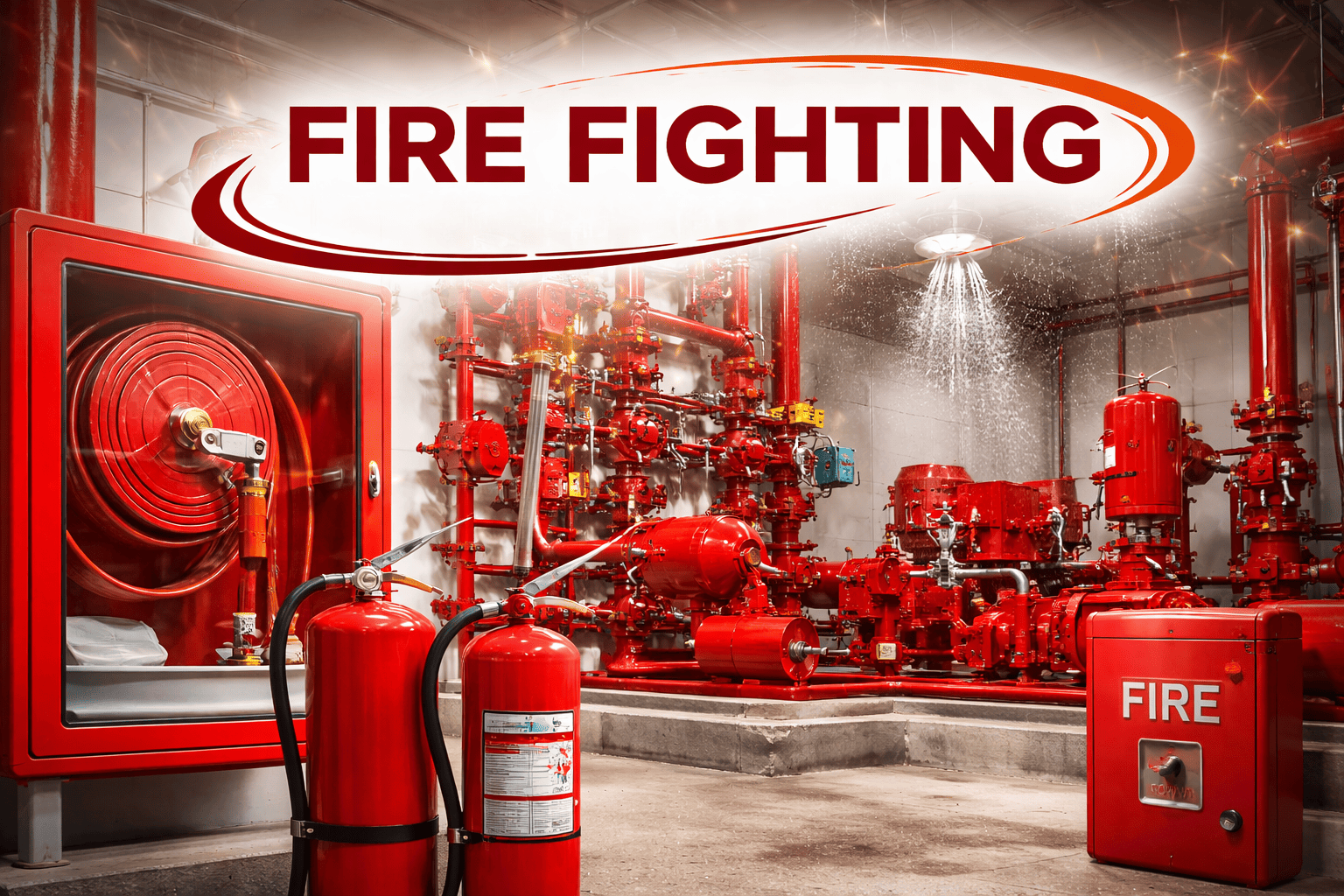
Fire fighting systems are essential safety solutions designed to detect, control, and suppress fires, minimizing risk to life, property, and critical infrastructure. These systems are engineered to respond quickly during fire emergencies, helping to contain fires at an early stage and allowing safe evacuation while reducing damage.
A complete fire fighting system typically includes fire detection and alarm systems, fire hydrants, sprinkler systems, hose reels, fire extinguishers, and specialized suppression systems such as FM-200, CO₂, or clean agent systems. These components work together to provide early warning, automatic activation, and effective fire control across different building zones.
Fire fighting systems are widely used in residential complexes, commercial buildings, factories, warehouses, hospitals, data centers, shopping malls, and high-rise structures. Modern systems are designed in compliance with national and international fire safety standards and can be integrated with building management systems (BMS) for centralized monitoring and control.
With reliable operation, quick response time, and robust design, fire fighting systems play a critical role in safeguarding lives, ensuring business continuity, and meeting statutory fire safety requirements..
Fire Alarm Systems
A Fire Alarm System is a critical life-safety solution designed to detect fire hazards at the earliest possible stage and provide immediate warning to occupants. By combining advanced detection technology with intelligent control and notification systems, it ensures fast response, safe evacuation, and minimized property damage.
Early Detection & Instant Alerts
Our fire alarm systems continuously monitor your premises for signs of smoke, heat, or flame. Once a threat is detected, the system activates audible alarms (sirens) and visual indicators (strobe lights) to alert occupants instantly. The system can also be configured to send remote notifications to security teams or emergency services for rapid intervention.
Key Components
-
Fire Alarm Control Panel (FACP): The central monitoring and control unit of the system.
-
Smoke Detectors: Detect smoke particles at early fire stages.
-
Heat Detectors: Respond to rapid temperature rise or fixed temperature thresholds.
-
Manual Call Points (MCP): Allow occupants to manually trigger the alarm in case of fire.
-
Sounders & Strobes: Provide audible and visual warning signals.
-
Communication Modules: Enable integration with monitoring stations and emergency services.
System Types
-
Conventional Fire Alarm Systems: Ideal for small to medium facilities, dividing the building into zones for fire detection.
-
Addressable Fire Alarm Systems: Advanced systems where each device has a unique address, allowing precise identification of the fire location.
-
Wireless Fire Alarm Systems: Flexible and easy-to-install solutions for retrofitting and heritage buildings.
🔗 Integration & Automation
Our fire alarm systems can be seamlessly integrated with:
-
Fire sprinkler and suppression systems
-
Public address and voice evacuation systems
-
Emergency lighting systems
-
Access control systems
-
Building Management Systems (BMS)